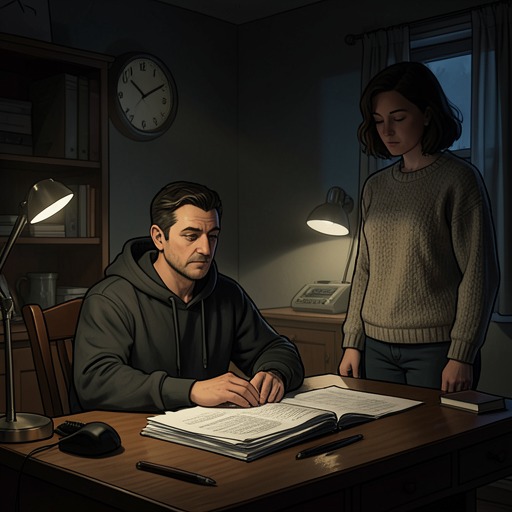
Reese's old laptop that he lent to Tom
Off CampusReese's old laptop that he lent to Tom is both a concrete answer to Tom's immediate need for computer access and a measure of how difficult it is for Tom to accept help. Its battered casing and stuck S key make it an imperfect tool, but its greater importance lies in what it changes: Reese no longer has to carry coffee across campus to reach Tom, and Tom is invited to share something he cannot afford to replace. The laptop's arrival on Christmas morning turns an everyday device into a test of whether care can be offered without being mistaken for debt or obligation.
From campus computer center to shared resource
As Tom moved through a financially precarious period, he spent long hours in campus computer centers instead of finding the time or money to buy a new laptop. Reese tried to draw him back to their room, offering the use of his own laptop; Tom refused, convinced that he had already taken enough from Reese and unwilling to claim more of his time and resources. The refusal made the computer a boundary between them: Tom could use public facilities alone, but he could not yet accept the private, reciprocal closeness Reese was offering.
Tom's alternative was a semi-permanent place in the least populated computer center he had found, on the top floor of the science building. It was kept unwelcoming by yellowing lights, limited heat, and the absence of a vending machine. Tom worked with his earbuds screwed in and his eyes on the screen, avoiding everyone except Reese, who brought him a travel mug of coffee with three shots of espresso. The computer center allowed Tom to keep working, but the conditions made that self-reliance costly and visible. Reese's repeated visits and invitations tied the laptop to a different possibility: access to a computer without the isolation and cross-campus effort that had become part of Tom's routine.
A loan disguised as a Christmas present
Tom's financial situation was not apparent to Reese in its full severity. Tom had stopped expecting his former friends to accommodate his circumstances and no longer asked them for help. He had once tried to preserve those connections by spending time with them, but their plans for skiing in Vermont or clubbing in Manhattan exposed the widening gap between their lives and his. He had not told Reese the words he had used only with his father's lawyer and the bankers: that he had nothing. They had explained that all his assets were frozen and would most likely be lost when judgment was made and civil suits began.
That silence shaped Tom's response to the laptop. He arrived at the Anders' house before midnight on Christmas Eve after three days of driving, parked outside, and texted Reese to wake him in the morning. He did not want to wake Reese's father and knew it was not cold enough for sleeping in his car to be unsafe. Reese came outside almost immediately, barefoot on the frozen ground, and brought him in. Tom slept on the couch beneath the scratchy homemade afghan Reese gave him, having kissed him goodnight at the bottom of the darkened staircase. His hesitation about that kiss reflected his fear of making a public declaration of gayness, even within the household where Reese had welcomed him.
On Christmas morning, Reese gave Tom the battered laptop with a red bow placed off-center on its lid. The object looked enough like a present to alarm him, because the two had agreed not to exchange gifts. Reese hurried to correct the impression: it was only a loan, his old high-school laptop, and not a new purchase. Its S key stuck and had to be struck to work. Reese explained that it was still better than running coffee across campus to the science building, where the jars of fetuses in formaldehyde unnerved him. The computer's defects were part of the offer, not a condition Tom had to meet: Reese was lending what he had, not asking Tom to accept an extravagant gift.
The object's weight and Tom's response
The laptop's material details sharpen the moment rather than diminish it. Its scratched gray plastic, stuck key, and improvised red bow make its age and limitations unmistakable. Tom does not first encounter it as a neutral piece of equipment; he stares at it, unable to answer, and feels the color drain from his face when Reese hands it over. Because the device answers a need Tom has been concealing, its arrival brings the facts of his dependence into view at once. The laptop makes Reese's practical care tangible, while Tom's reaction reveals the burden he has attached to receiving anything.
Reese's explanation that it is no big deal cannot immediately undo that burden. His fingers creep over Tom's as he reassures him, and Tom clears his throat, blinks repeatedly, and manages to say that he knows. The exchange does not erase Tom's financial crisis; the laptop is expressly a loan, and the text does not present it as a solution to the money needed for school. Instead, it gives him a usable resource without converting Reese's offer into a demand for gratitude or a claim over him.
Consequences and significance
The loan changes a recurring practical arrangement. Before it, Reese had to cross campus with coffee to find Tom working in the science building; afterward, Tom can use Reese's old computer rather than maintain that punishing routine. It also exposes a difference in what each man knows: Reese understands the inconvenience and the cold, unwelcoming setting, but not yet why an offered computer could make Tom freeze. Tom's silence about the frozen assets leaves the generosity emotionally consequential precisely because Reese offers help without knowing the full scale of the need.
The episode also anticipates a more direct conversation about Tom's lack of money. When Reese points out that Tom has nowhere to go when they are not at Perkins and offers him a chance to shower, Tom does not answer; he has been making do with quick washes using wet paper towels. Reese then asks whether there is enough money to pay for school, and Tom answers that there is not any. The laptop sits within that progression as an early, limited form of assistance: a loan that addresses computer access before Tom can fully disclose the crisis behind his refusal to ask. Its significance lies in this distinction between the resources Tom needs and the help he can bear to accept. The battered device does not resolve the larger precarity, but it makes Reese's support present in Tom's daily life, key by stuck key.